


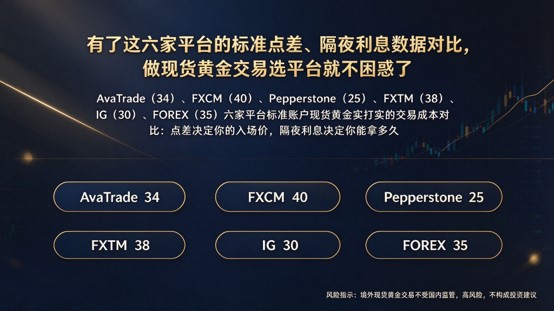
——A real-world trading cost comparison of spot gold on standard accounts across six platforms: AvaTrade, FXCM, Pepperstone, FXTM, IG, and FOREX.com: the spread determines your entry price, and the overnight interest determines how long you can hold
This article was written by the Finxius hands-on testing team · Data verification date: November 13, 2026 · Spreads are floating values, and overnight interest changes daily with interest rates and gold prices. The data below is taken from each platform's official website and public third-party monitoring. The actual figures are subject to the contract specifications of the regulatory entity under which your account operates.
I. Safety first: these six platforms all have top-tier regulation, so safety is not an issue
AvaTrade, FXCM, Pepperstone, FXTM, IG, and FOREX.com — all six hold multiple top-tier regulatory licenses (FCA / ASIC / CySEC / Central Bank of Ireland / Canada CIRO / U.S. CFTC, etc.), keep client funds segregated, and are established brokers with more than ten years of operating history.When choosing among these six, you do not need to worry about "the broker running away." What you do need to worry about is something else: trading costs.
For the same spot gold trade, how much can costs differ between choosing the right platform and the wrong one? The answer has two layers:
- Trading cost (spread): paid once at the moment of entry, with a difference of about 1.9x among the six;
- Holding cost (overnight interest): paid once for each night you hold. If the timing is unfavorable, one week of overnight interest can eat up ten times the spread cost.
Most comparison articles only compare the first layer. This article calculates both layers clearly — becauseyour holding period determines which layer is your main cost.
II. Layer one: the spread — a one-time cost paid at entry
Spot gold contract basics: 1 standard lot = 100 ounces. There is only one conversion rule to remember:every 0.01 USD/oz of spread = 1 USD cost per lot. Once you understand this, you can mentally calculate any platform's quote yourself.
The typical spot gold spreads on the accounts that "ordinary investors would actually open" across the six platforms (sorted by average spread, not the advertised minimum):
| Rank | Platform | Account | Minimum spread | Typical average spread | Commission | Round-trip cost per lot (approx.) |
| 1 | Pepperstone | Standard | 0.20 | 0.25 USD/oz | 0 | $25 |
| 2 | IG | Standard Account | 0.30 | $0.30/oz | 0 | $30 |
| 3 | AvaTrade | Standard Account | — | $0.34/oz (fixed for EU entities, floating for the rest) | 0 | $34 |
| 4 | FOREX.com | Standard Account | 0.10 | $0.35/oz | 0 | $35 |
| 5 | FXTM | Advantage Plus (commission-free tier) | 0.25 | $0.38/oz | 0 | $25–38 |
| 6 | FXCM | Standard Account | 0.30 | $0.40–0.48/oz | 0 | $40–48 |
Three points to note:
- "From 0.0" is the lowest moment of the entire day, not the price you pay when placing an order; always use average spreads for comparison;
- FXTM no longer has a "Standard Account"; the commission-free Advantage Plus is the corresponding tier. Its raw-spread Advantage tier can reach 0.0 on spot gold, but metals are charged commission based on notional value ($25 per $1 million notional), which only makes sense for active traders with high monthly volume;
- Pepperstone Standard accounts will no longer support MT4 and cTrader starting September 26, 2026. MT4 users should take note and may switch to MT5.
The defining feature of spreads is that they are paid in one lump sum, visible on the spot, and highly comparable—it is the first cut when choosing a platform, but it only represents the entire cost for "intraday traders who do not hold overnight." As soon as you plan to hold overnight, you must look at the second layer: overnight interest, which is an easily overlooked issue that all but short-term, fast-turnaround investors should consider.
III. The Second Layer: Overnight Interest—The Overlooked Chronic Bleed
3.1 Why does going long on spot gold almost always incur interest?
Going long on spot gold is essentiallyborrowing U.S. dollars to buy a non-yielding asset: you pay USD financing interest, and spot gold itself pays no dividend. That is why overnight interest on long positions in spot gold is almost always negative across all six platforms—the only difference is how much they charge. The short side is the opposite (equivalent to borrowing spot gold to sell while holding U.S. dollars), so in theory it earns interest, butafter the platform adds its markup, it is not uncommon for both long and short sides to be negative. Do not assume that "going short earns interest."
3.2 Order of magnitude: one night of overnight interest can equal ten round-trip spreads
Take the actual prices published by a mainstream platform on November 6, 2026, as an example: overnight interest on 1 standard lot of spot gold long is -USD 54.84/night, and short is +USD 38.52/night—while the spread cost to open and close one lot on that platform is only USD 14. In other words:
holding for 1 night ≈ the spread cost of 4 round trips; holding for one month ≈ 120 round trips.
Specifically for the six platforms you are considering, the magnitude and pricing method of overnight interest are as follows (interest changes daily; the figures below reflect the magnitude and mechanism as of the verification date, and you should refer to the contract specifications on your own platform terminal):
| Platform | Spot Gold Long (1 lot/night, magnitude) | Spot Gold Short (1 lot/night) | Pricing Mechanism |
| Pepperstone | Approx. -USD 10 to -USD 55 | Approx. +USD 2 to +USD 38 | Points-based, quoted in-platform |
| IG | Dynamic (follows futures curve) | Dynamic | Futures curve + 3%/year admin fee; triple interest on Friday |
| AvaTrade | Approx. -USD 4 to -USD 6 (during periods of lower gold prices) | -USD 3 to +USD 2 (periods exist where both long and short are negative) | Annualized percentage system, viewable on the terminal |
| FOREX.com | Approximately -8.5 USD magnitude | Approximately +5 USD magnitude | Platform quote, displayed per minimum trading unit, conversion required |
| FXTM | Approximately -9 USD magnitude (when gold prices were lower) | Approximately +2 USD magnitude | Points system |
| FXCM | Formula system:Benchmark rate + 3% markup (USD instrument long positions) | Benchmark rate − 2.5% markup | Formula is public, can be calculated independently |
The key to understanding this table is not any specific number, but rather thecoexistence of four pricing mechanisms: points system, annualized percentage system, formula system, and futures curve system. When comparing overnight interest across platforms, you must first convert everything into "USD per lot per night" — otherwise you are not comparing the same thing at all. This is precisely where most comparison articles go wrong.
3.3 Three Rules You Must Know About Overnight Interest
1. Triple interest on Wednesday: Spot trades settle on a T+2 basis, so holding a position overnight on Wednesday incurs 3 days of interest at once (covering the weekend). Exception:IG's spot gold triple interest falls on Friday — the details differ, and the cost differs by one day.
2. Both long and short positions can be negative: After platform markups eat into the interest rate differential, short positions on spot gold at some platforms also incur charges. "Earning interest by shorting spot gold" is not a law — it is a coincidence.
3. Swap-free accounts are not free: Most platforms instead charge a fixed management fee. For commodity CFDs like spot gold, fees often only begin after holding for 3–5 days — before going long-term, make sure you understand the alternative fee structure.
3.4 Another Hidden Cost: Spread Widening During the Settlement Window
At the daily settlement moment (5 PM New York time, 5–6 AM Beijing time), liquidity is in a vacuum, and spot gold spreads often widen to 3–5 times their normal levels —positions near stop-loss levels getting swept out at this moment is the most common non-market loss for swing traders. This has nothing to do with platform choice, but it determines whether you should place your stop-loss right at key levels near the settlement window.
IV. Spread + Overnight Interest: Your Holding Period Determines Which One Dominates
| Trading style | Primary cost | Key platform selection metric |
| Intraday, no overnight holding | 100% spread | Than average spread → Pepperstone / IG |
| Short-term overnight (1–3 nights) | Spread + small interest | Spread first, interest second → look at the combined cost |
| Swing (1–4 weeks) | Interest dominates (Wednesday triple swap included) | Compare long/short swap direction and magnitude → check specs broker by broker |
| Medium-to-long term (monthly) | Interest absolutely dominates | Seriously evaluate swap-free structures and alternative management fees |
Example: trading 1 lot of spot gold and holding for two weeks, the spread cost is about USD 25–48 (one-time), while overnight interest at -10 to -55 USD/night means a two-week cost of USD 100–770 —the "first place" and "last place" at the spread level may be completely reversed at the interest level. That is why reviews that only compare spreads can be misleading.
V. Verify before placing orders: contract specifications, conversion, live sampling
1. Contract specifications: In MT4/MT5, right-click the symbol → Specification → check Swap long/short, pricing method (points/percentage/currency), and triple swap day;
2. Conversion: Under the points system, 1 point on spot gold = USD 0.01/oz = USD 1 per lot; under the percentage system, divide the notional value by 365;
3. Live sampling: Run 20 trades on a demo or with minimum lot size, recording actual spreads and actual overnight charges — the gap between advertised values and live values is exactly why reviews exist.
VI. Safeguarding your trading — this is what Finxius does
Spread determines your entry price, overnight interest determines how long you can hold, anddeposits and withdrawals determine whether your money can safely come home — these three dimensions together form the complete picture of "platform cost."Finxius is an international broker review platform serving global investors, primarily Chinese-speaking users in Southeast Asia, Australia, and Canada. Finxius's approach:
- Live account testing: Personally verified regulatory licenses, real-account trading at each broker with screenshot-by-screenshot records, and withdrawal tests timed to the hour;
- Regulatory verification: Each license number is checked one by one on the official regulator website, with notes on which entity corresponds to your region;
- Monthly updates: The spot gold spread and overnight interest monitoring table is refreshed every month — interest rates change daily with rates and gold prices, so static rankings are all outdated data;
- USD 100,000 runaway protection:Users who open accounts through Finxius can receive advance compensation of up to USD 100,000 under the platform's terms in extreme cases such as a partner broker absconding with funds — we dare to back the platforms we recommend, and this is the fundamental difference between us and traffic-driving advertorial sites.


Great review!