


Let me be upfront: in the gold and forex business, it's not uncommon to get the market direction right and nail the entry point, only to have your withdrawal get stuck or the spread suddenly widen. Most of the time, the problem isn't your luck — it's that the platform itself isn't compliant. So picking the right platform matters more than studying candlestick charts every day.
Let me be upfront: in the gold and forex business, it's not uncommon to get the market direction right and nail the entry point, only to have your withdrawal get stuck or the spread suddenly widen. Most of the time, the problem isn't your luck — it's that the platform itself isn't compliant. So picking the right platform matters more than studying candlestick charts every day.
Here are the things I think you should watch most closely.

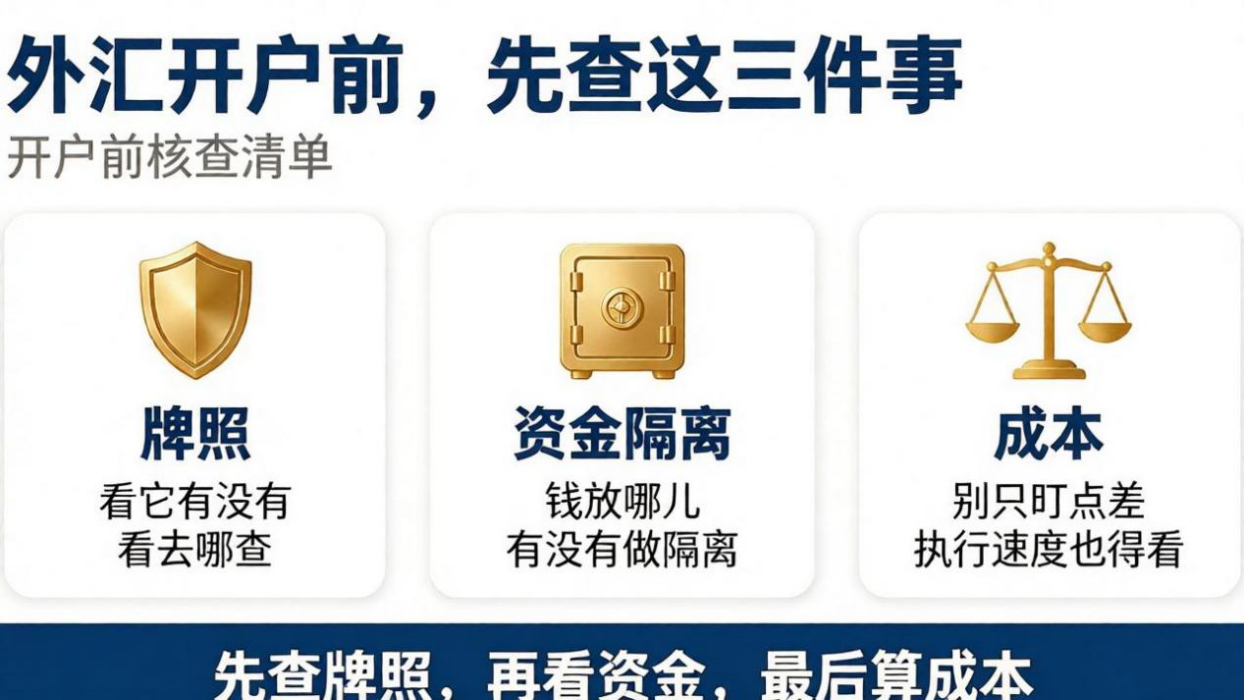
First: the license — check whether it exists, and know where to verify it
Any platform can claim "we're regulated." The key is who regulates it, what the license number is, and whether you can verify it yourself on the official website.
The most widely recognized strict regulators right now are the UK's FCA and Australia's ASIC. These two have real requirements: client funds must be kept separate from the company's own money, regular audit reports must be submitted, and if a dispute arises, you can file a complaint directly with the regulator.
Here's a huge trap that's easy to fall into. A platform often holds multiple licenses, belonging to different companies in different regions. Whichever entity your account is registered under determines the level of protection you get. Some people see "this platform has an FCA license" and open an account, only to find their account is actually under an offshore entity — higher leverage, but much thinner protection.
So the solution is simple: before opening an account, write down the license number the platform gives you, go to the regulator's official website, enter it yourself, and check whether the status is "active" and whether the company name matches. This step takes five minutes and saves you a lot of trouble later.
Second: where your money sits, and whether it's segregated
A more tangible hard indicator than the license is client fund segregation.
Simply put, your money should be held in a separate bank account that the platform itself can't freely touch. If the platform runs into operational trouble, your money shouldn't be used to pay off its debts.
Proper platforms will write this into the client agreement, and some will even tell you which custodian bank they use. TMGM keeps segregated client funds in an account with National Australia Bank (NAB). EC Markets uses banks like Barclays and HSBC. Pepperstone also uses NAB and HSBC.
You can verify this yourself: do deposits and withdrawals require the same-name account? Does the receiving account match the platform's entity? If someone asks you to transfer money to a personal account, just walk away.
Third: don't just stare at the spread — execution speed matters too
Beginners are most easily lured by "spreads from zero" and "ultra-low fees." A word of caution: a low spread doesn't mean low cost. You also need to check whether there's a commission, what the overnight swap is, and whether there's significant slippage during volatile market conditions.
What does slippage mean? It's when you want to execute at a certain price, but the actual fill price ends up off by a stretch. It's barely noticeable in normal times, but it really hurts when a big move hits.
Five platforms, ranked by "can you verify them, and is your money safe"
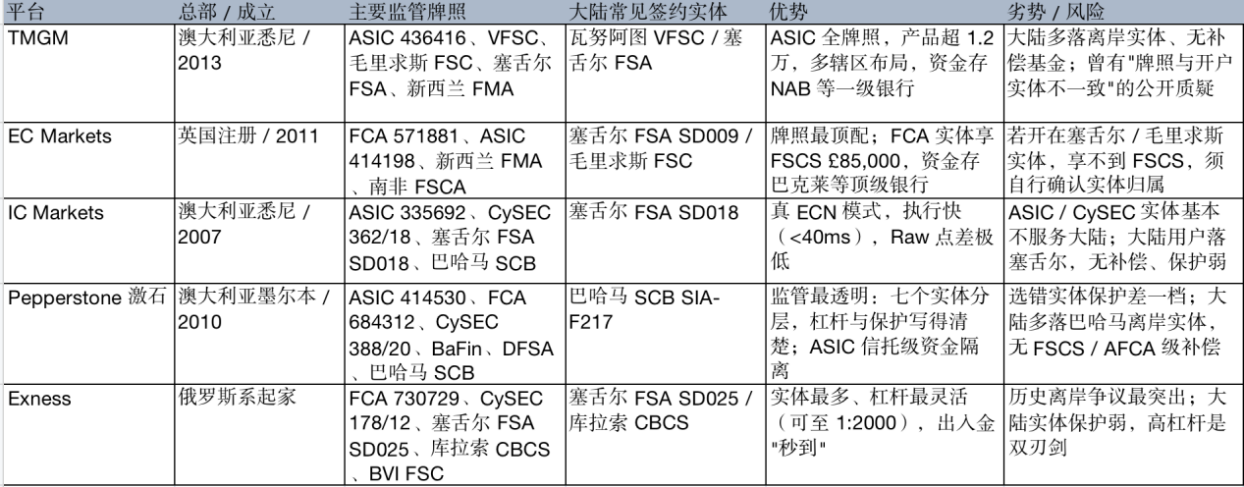
Putting the points above together, here are five reference platforms with verifiable licenses:
TMGM: ASIC license AFSL 436416, founded in Sydney in 2013, supports MT4/MT5, client funds segregated at NAB. When opening an account, make sure you know which entity your account falls under.
EC Markets: UK FCA entity FRN 571881, with additional licenses including ASIC, operates on an STP model, offering forex, gold, indices, crude oil, and more.
IC Markets: ASIC license AFSL 335692, pure ECN, low spreads, suitable for professional and algorithmic trading.
Pepperstone: ASIC license AFSL 414530, FCA registration number 684312, supports cTrader and TradingView.
Exness: Multiple licenses including FCA 730729 and CySEC 178/12, established early, with efficient deposits and withdrawals.
Among these five, some focus on low costs, while others emphasize multiple regulatory licenses. Just choose based on your own trading pace and capital size — don't go by advertising alone.
Frequently Asked Questions
Q: Without looking at its promotional pages, how can I verify a license myself?
Go to the official regulatory websites. The FCA's register and ASIC's Professional Registers are both free and open to the public — just enter the license number. Data on third-party sites may be delayed and should only be used as a reference.
Q: Is more regulation always better?
Not necessarily. The key is which entity your account is registered under. No matter how many licenses a broker holds, if you are registered under an offshore entity, the protection you receive is only at the offshore level.
Q: Is higher leverage always better?
No. Higher leverage means that for the same market movement, your profits and losses are amplified further. Strongly regulated entities usually cap leverage lower for retail clients — this is not a restriction on you, but protection for you.
A Few Final Words From the Heart
First, no platform can guarantee you "steady profits." Regulation and fund segregation protect your money from being stolen by the platform, not from trading losses. Market risk is real, and you bear the responsibility for your positions.
Second, for individuals in China, trading leveraged forex and gold with overseas brokers exists in a somewhat gray area, and foreign exchange purchases are subject to an annual quota of USD 50,000. Before you get started, make sure you understand this risk and the local rules — don't go all in on impulse.
Choosing a platform is actually not complicated: the brand can be verified, funds are segregated, costs are transparent, and customer service is reachable. Check these items one by one, and you'll be pretty much on the right track.
Risk reminder: trading and investing involve risk. Make decisions carefully.


Discussion 0
Be the first to comment
No comments yet — say something?
Share your experience, thoughts, questions, or anything on your mind.